Most homeowners assume that if they don’t have a large tree sitting directly over their sewer line, they don’t have to worry about tree roots.
Unfortunately, that’s one of the biggest myths in plumbing.
The truth is, there could be a tree 20 or even 30 metres away that’s slowly making its way towards your drains right now.
Your drains could already be under attack
Tree roots aren’t aggressive. They’re simply searching for two things: water and nutrients.
Underground, thousands of fine feeder roots spread through the soil like tiny fingers, constantly exploring for moisture. They don’t grow randomly. They grow towards the easiest and most reliable source of water and nutrients they can find.
Your sewer pipe is exactly that.
Even a tiny crack, worn rubber seal or slightly separated pipe joint allows a small amount of moisture to escape into the surrounding soil.
You’d never notice it.
But the tree does.
That tiny leak acts like a beacon, attracting roots directly towards your drain line.
Why sewer pipes are a magnet for tree roots
Most people think tree roots damage pipes because they’re powerful enough to break through them.
The reality is quite different.
Tree roots rarely penetrate a sound pipe. Instead, they find an existing weakness and take advantage of it.
A worn rubber ring, cracked pipe or loose joint allows microscopic amounts of nutrient-rich wastewater to seep into the surrounding soil. To a tree, this is like following the smell of food.
Sewer pipes don’t just carry water. They carry organic matter and nutrients such as nitrogen and phosphorus that trees need to survive and grow.
Once a feeder root discovers this constant source of moisture and nutrients, it continues growing towards it.
When it enters the pipe through a tiny opening, it finds the perfect environment:
- A constant water supply
- Warm temperatures
- Nutrient-rich wastewater
- An endless source of moisture
What started as a root no thicker than a strand of hair quickly branches into hundreds of fine roots, creating a living network inside your drain.
“But the tree is nowhere near my house…”
That’s what surprises most homeowners.
A tree’s root system can extend one to three times the tree’s height.
That means:
- A 10-metre tree can have roots extending up to 30 metres.
- A large gum tree can spread beneath your driveway, your lawn, your neighbour’s yard and your underground plumbing.
- Roots often travel well beyond the visible canopy in search of water and nutrients.
So just because the tree isn’t above your pipes doesn’t mean it can’t reach them.
In many cases, the tree causing the blockage isn’t even on your property.
What happens once roots get inside?
Once inside the pipe, the roots don’t stop growing.
They spread throughout the drain, creating a dense web that acts like a fishing net.
Every flush carries toilet paper, grease, soap residue and waste through the pipe. Instead of flowing freely, this material catches on the root fibres.
A little builds up.
Then a little more.
Months later, what started as a tiny feeder root has become a thick, matted blockage restricting the entire drain.
Eventually, the pipe struggles to carry wastewater away from your home.
That’s when the problems begin.
Why does my drain keep blocking?
If you’ve had your drain cleared before and the problem keeps coming back, tree roots could be the reason.
Many temporary drain clearing methods simply punch a hole through the blockage to restore flow.
The root system remains alive.
It continues growing, trapping more debris until the drain blocks again.
That’s why recurring blocked drains are one of the strongest indicators of tree root intrusion.
Without removing the roots and repairing the point where they entered, the problem will almost always return.
Common warning signs
You might notice:
- Drains becoming slower over time
- Toilets gurgling after flushing
- Recurring blockages in the same location
- Sewer smells around the property
- Water backing up during showers or laundry use
- Overflowing inspection openings after heavy water use
Most sewer failures don’t happen overnight.
They slowly deteriorate over months or years until one day the system stops working altogether.
The expensive part isn’t the blockage
The expensive part is ignoring it.
A tiny root entering a pipe today can eventually force joints apart, crack ageing pipework and cause complete drain failure.
What could have been resolved with preventative maintenance may end up requiring excavation, pipe replacement and restoration of driveways, gardens or landscaping.
The earlier the issue is identified, the more options you have and the lower the repair cost is likely to be.
How we find the real problem
At Projection Plumbing, we don’t believe in simply clearing a blockage and hoping for the best.
We use CCTV drain cameras to inspect the entire pipeline and identify exactly where the roots are entering.
From there, we can:
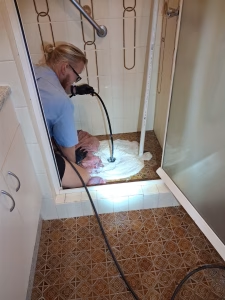
- Remove roots using specialised cutting equipment and high-pressure water jetting
- Flush accumulated debris from the drainage system
- Locate damaged sections of pipe
- Recommend repairs or pipe relining to prevent future root intrusion
The goal isn’t just to get the water flowing today.
It’s to stop you dealing with the same problem six months from now.
The key takeaway
Tree roots aren’t trying to damage your home.
They’re simply following water and nutrients.
But once they discover your sewer pipe, they turn a tiny crack or loose joint into a living tunnel that continues growing year after year.
If you’ve experienced recurring blocked drains, slow drainage, gurgling toilets or sewer smells, don’t assume it’s “just another blockage.”
It could be a hidden root system that’s been growing beneath your property for years.
Understanding what’s happening underground today could save you thousands of dollars in repairs tomorrow.
The best time to investigate a recurring blocked drain is before it becomes an overflowing sewer.
See also: How We Remove Tree Roots From Drain Pipes (And Why Simply Clearing the Blockage Isn’t Enough).
See also: Signs Your Property’s Drain System Is Backing Up Again.